
Measuring Companies on a Bitcoin Standard with Sats per Share

Key Takeaways
New Metrics for Companies with Bitcoin Treasuries: As more public companies add Bitcoin to their balance sheets, Sats per Share and Sats per Dollar per Share provide new non-GAAP metrics that offer investors a clearer view of Bitcoin exposure and enable relative comparisons across companies.
Accounting for Bitcoin Miners’ Dilution and Operational Efficiency: Sats per Share helps investors assess the operational efficiency and core business performance of Bitcoin miners, adjusted for dilution.
Expanded Sats per Share Metrics for Bitcoin Miners: Daily Sats Production per Share and Annualized Production-to-Share Price Yield are additional metrics introduced to assess Bitcoin miners’ bitcoin denominated cash flow generation potential.
Limitations of Sats per Share: A key limitation of the sats per share metric is its lack of adjustment for the relative value of a company’s enterprise value compared to its Bitcoin holdings, which investors should consider in relative valuation comparisons.
Introduction
The adoption of Bitcoin as a strategic asset by public companies has introduced new challenges for investors seeking to assess their financial performance. Traditional financial metrics often fail to capture the impact of Bitcoin on a company’s balance sheet and shareholder value. Companies like MicroStrategy, with its aggressive Bitcoin acquisition strategy, and publicly traded Bitcoin mining companies, which generate revenue directly in Bitcoin, require new methods of evaluation.
One such method is the Sats per Share metric, which quantifies Bitcoin ownership per share, offering investors a clearer picture of a company’s Bitcoin exposure. This metric not only helps to measure capital efficiency but also accounts for the dilutive effects of equity issuances, making it a valuable tool for assessing the long-term financial health of companies with Bitcoin treasury strategies. By incorporating this metric, investors can compare companies based on their Bitcoin holdings and better understand the operational performance of company’s overtime by assessing their growth rate trend in the sats per share metric.
This report explores the development and application of sats per share as a financial metric, examining its relevance for companies like MicroStrategy and Bitcoin mining firms. Through an analysis of these companies, we highlight the potential of sats per share to become a standard tool for evaluating firms operating under a Bitcoin-centric financial model, while also addressing its limitations and how it can be adapted for various use cases and industries.
Why Companies Are Considering Implementing a Bitcoin Treasury
Accounting Rule Changes for Bitcoin: In 2023, the Financial Accounting Standards Board (FASB) approved a new standard for reporting crypto assets, including Bitcoin, using fair value accounting. This change allows companies to recognize price appreciation in their Bitcoin holdings, whereas previously, they could only report impairments in value.
Defending Against Inflation: Companies like MicroStrategy have adopted Bitcoin as a reserve asset, viewing it as a more robust means of preserving cash value against inflation.
Broadening the Investor Base: Investor demand for Bitcoin exposure and for companies that trade with a high beta to Bitcoin is growing. By holding Bitcoin on their balance sheets, companies can attract a new demographic of investors interested in digital asset exposure.
Providing Growth Opportunities: As bitcoin appreciates from becoming a part of the global financial ecosystem, holding Bitcoin on the balance sheet and capturing the upside may allow companies to grow their market capitalization faster than growing their core business.
Bitcoin’s Growing Acceptance in the Global Financial Market: With the approval of the Bitcoin spot ETF and increasing regulatory clarity, it has become less challenging and less risky for companies to include Bitcoin in their treasury strategies.
Bitcoin Utility: Bitcoin held on the balance sheet can be leveraged through Bitcoin-backed loans or structured financial products. This provides access to capital for reinvestment in the core business, additional Bitcoin acquisition, or share buybacks.
Sats per Share Methodology
Sats per Share: Bitcoin holdings on balance sheet divided by fully diluted shares outstanding
Sats per Dollar per Share: Sats per Share divided by current share price
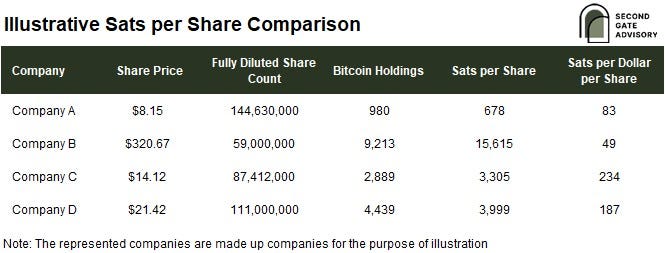
Sats per Dollar per Share is a relative value metric that can be used to compare companies across different industries who have adopted a bitcoin treasury management strategy.
For investors seeking Bitcoin exposure, outperforming Bitcoin itself is emerging as the new benchmark, overshadowing the traditional benchmark of the S&P 500. The Sats per Share metric provides a valuable lens to assess whether a company’s core operations can deliver better returns than a direct Bitcoin investment. As more companies shift their treasury to a Bitcoin standard, Sats per Share encourages investors to scrutinize free cash flow and share dilution highlighting how effectively a company’s core business drives Bitcoin accumulation compared to its peers. Within this framework, investors are encouraged to place less emphasis on core business growth unless it directly contributes to sustained increases in free cash flow and Sats per Share over time.
Limitations and Drawbacks of the Metric
A key limitation of the sats per share metric is that it doesn’t account for the enterprise value of the company’s core business. If a company’s core business is significantly more valuable than their Bitcoin holdings then their sats per share may not look very compelling when comparing it with other companies.
To account for this, investors may need to exclude the enterprise value of specific business segments and divide the remainder by the fully diluted share count to derive an adjusted price per share for more accurate comparisons.
Investors can also focus on the quarter-over-quarter or annual growth rate of sats per share to better evaluate performance trends. Companies with higher sats per share and sats per dollar per share metrics are expected to have a stronger correlation and higher beta relative to Bitcoin.
An Analysis of Sats per Share for MicroStrategy
MicroStrategy offers a unique example of a company that has adopted a Bitcoin accumulation (or “hodl”) strategy to drive growth. It leverages stable and predictable cash flow from its core SaaS business to issue long-dated convertible notes, using the proceeds to accumulate Bitcoin on its balance sheet. This approach enables the company’s market capitalization to grow alongside Bitcoin’s value.
Before the approval of spot Bitcoin ETFs, MicroStrategy functioned as the closest proxy to a Bitcoin ETF accessible to traditional investors. As a result, its stock price is highly correlated with Bitcoin's price, and the leveraged nature of its Bitcoin acquisition strategy gives the stock a high beta relative to Bitcoin.
Given its role as a Bitcoin ETF proxy, evaluating MicroStrategy through the lens of sats per share is highly relevant. Since the company finances its Bitcoin purchases through dilutive capital-raising efforts, tracking the growth of sats per share over time is critical to assessing the effectiveness of its strategy.
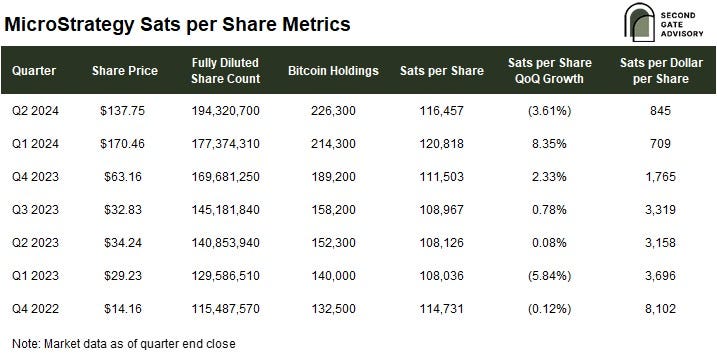
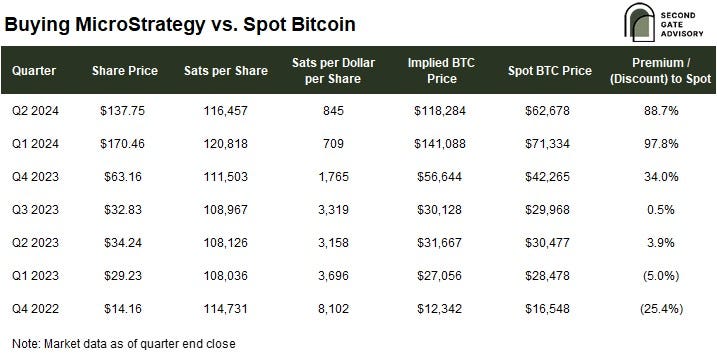
Given that MicroStrategy functions as a synthetic Bitcoin ETF, it makes sense for investors to compare buying MicroStrategy shares from a sats per share perspective against purchasing spot BTC, shares in a Bitcoin ETF, or bitcoin mining companies. Historically, MicroStrategy has traded at a premium to spot BTC and Bitcoin ETFs due to its leveraged beta. However, the analysis below raises the question of whether MicroStrategy warrants such a high premium over spot BTC and ETFs.
One way to evaluate this premium from a sats per share perspective is to consider based on the market’s valuation of MicroStrategy how much additional Bitcoin MSTR would need to acquire in order to make buying MicroStrategy shares on par with or better than buying spot BTC. As of Q2 2024, MicroStrategy was trading at an 88.7% premium to spot, meaning that for investors to break even with buying spot BTC, MicroStrategy would need to acquire an additional 200,728 BTC, net of dilution. MicroStrategy’s premium to spot has since increased to roughly 200% based on its current bitcoin holdings of 252,200 and share price of $255 as of 10/28/2024. It is also important to note that the analysis below does not factor in the dilutive impact of any convertible notes coming to maturity which would further increase the premiums relative to spot BTC.
Sats per Share for Bitcoin Mining Companies
Historically, publicly traded Bitcoin mining companies have been awarded market premiums based on growth metrics such as hashrate expansion and future targets. Consequently, many miners have optimized for growth at all costs, even when it led to poor return on capital metrics, and significant levels of share dilution. However, given the capital-intensive, commodity-based nature of mining, investors should prioritize return on invested capital (ROIC), payback periods for new projects, and free cash flow generation.
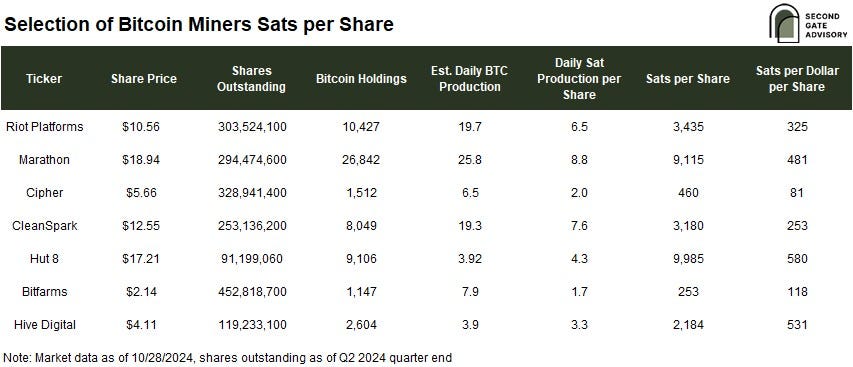
Investors have also traditionally rewarded miners that maintain a large Bitcoin hodl balance and the companies that have demonstrated the ability to hold and accumulate a significant percentage of the Bitcoin they mine. While not a perfect metric for miners, sats per share and sats per dollar per share can give mining companies a way to showcase their operational efficiency relative to peers, aligning with investor interest in Bitcoin mining. Most importantly, stats per share can highlight the profitability of mining operations net of dilution on an apples-to-apples basis.
Expanding on Sats per Share for Bitcoin Miners
Not all Bitcoin mining companies follow a hodl strategy, and many have diversified into areas like high-performance computing (HPC) and artificial intelligence (AI). Therefore, the sats per share metric is most effective when applied to companies that follow a hodl strategy and remain pure-play Bitcoin miners. For companies with diversified operations, investors should adjust by excluding the enterprise value of non-mining segments for a more accurate comparison.
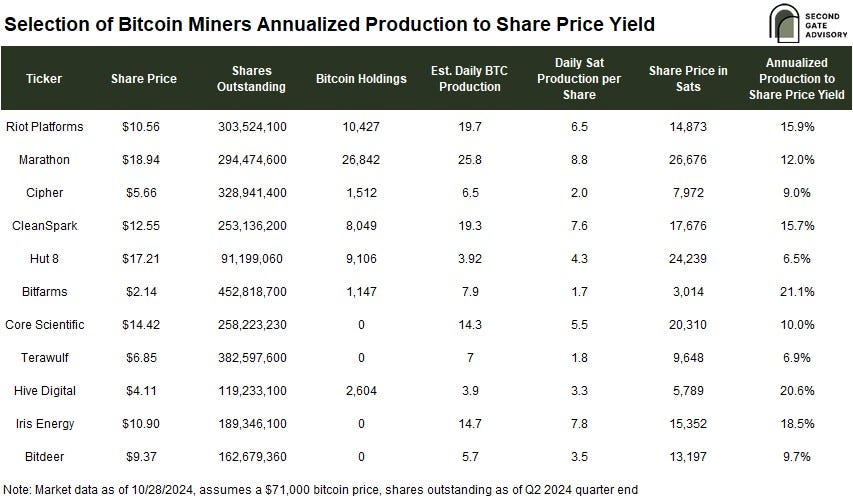
Given that Bitcoin miners generate cash flow directly in Bitcoin, there are ways to expand the sats per share metric to provide deeper insights into their operational performance. In addition to sats per share and sats per dollar per share, we introduce two new metrics:
Daily Sat Production per Share: This metric is calculated as the current network hashvalue multiplied by the company’s current hashrate, divided by fully diluted shares outstanding.
Hashvalue: The expected amount of sats earned per day by unit of hash power usually measured in terhashes or petahashes. Calculated as bitcoin block subsidy plus average fees per block multiplied by 144 (estimated blocks per day) multiplied by 100 million (to convert BTC to sats) divided by network hashrate (in terahash).
Daily Sat Production per Share shows the amount of Bitcoin an investor would theoretically accrue per day (before expenses like electricity and SG&A) for holding one share of the company. The metric aims to capture the relationship between a company’s current market value and its current Bitcoin production. This is crucial because hashrate today is significantly more valuable than future hashrate due to increasing mining difficulty. This metric can also provide insights into how much future growth is priced into a miner’s stock relative to its peers. However, it does not account for fleet efficiency, power costs, or payroll expenses, so investors should consider these factors when comparing miners.
Annualized Production-to-Share Price Yield: This metric is calculated by taking the daily sat production per share, multiplying it by 365 (days in the year), then dividing by the current share price, dividing again by the current Bitcoin price, and finally multiplying by 100 million (to convert to sats).
The daily sat production per share metric also serves as a key input for the annualized production-to-share price yield, offering another layer of insight into the operational efficiency of mining companies. The goal of this metric is to show how much Bitcoin an investor could effectively "buy" for the price of a single share of a mining company, and to calculate the percentage of Bitcoin the company would mine to recoup your initial investment over the course of one year, based on its current daily production rate. The implied Bitcoin yield can be used as a benchmark against other Bitcoin yield products. In some respects, this metric can be thought of as analogous to a cap rate in real estate, providing a way to assess the income-generating potential of Bitcoin mining companies relative to their share price.
Additionally, this metric can be adjusted by incorporating an investor’s own assumptions about network hashvalue to better understand the impact of a high-fee regime or increases in network difficulty on the implied Bitcoin yield. If an investor wants to account for future hashrate growth, they can calculate the weighted average hashrate for the next 12 months and use that as an input in the calculation. However, factoring in future hashrate growth assumptions won’t account for future dilution that is potentially required in order to obtain that future hashrate and should be considered in your analysis.
Conclusion
As Bitcoin continues to become a part of the global financial economy and as more companies add Bitcoin to their corporate treasury there will be an increasing need for metrics like sats per share, which can allow investors to assess operational performance and Bitcoin exposure more clearly. For companies with a strong focus on Bitcoin, like MicroStrategy and publicly traded Bitcoin miners, sats per share and related metrics, such as daily sat production per share and annualized production-to-share price yield, offer a meaningful way for investors to evaluate operational efficiency and growth in Bitcoin exposure net of dilution. While these metrics add clarity, especially for pure-play Bitcoin companies, investors should remain mindful of each metric's limitations, especially for firms with diversified operations. As Bitcoin adoption continues, these metrics could play a central role in guiding investor understanding and comparison of Bitcoin exposure across various companies.